



The most useful probiotic ingredient comparison begins with the exact organism and strain, its viable amount, and the human outcome measured—not with a product's total number of named bacteria. This guide explains how to examine oral-health formulations, including advertised DentaVive ingredients, without confusing a studied species with a validated finished product.
Affiliate disclosure: This guide contains affiliate links. A qualifying purchase may earn the publisher a commission. The merchant, not MenPS, handles orders and payment.
BUY PRODUCT — Review current oral-wellness purchase options: Check the DentaVive offer. Seller prices, packages, shipping, refunds and offers require confirmation at checkout.
Species names are not the whole identity
Scientific names often include genus and species, but probiotic research commonly investigates a particular strain. Two products can display the same species and still contain different strains, preparations or combinations. They cannot automatically inherit each other's trial results. Taxonomic renaming adds another challenge: different names may refer to closely related organisms or newly assigned genera, so buyers should compare identifiers carefully.
The systematic review by Inchingolo and colleagues summarizes clinical investigations involving Lactobacillus reuteri, Weissella cibaria, Bifidobacterium animalis subsp. lactis HN019 and other preparations. Those investigations measured different populations, durations and outcomes, including halitosis, probing measurements and microbial counts. Their findings do not establish one ideal universal dental-probiotic blend.
Compare research endpoints, not product slogans
A result involving reduced Streptococcus mutans in saliva is not equivalent to proof of fewer future cavities. Improvement in periodontal probing after conventional treatment plus a studied probiotic is not equivalent to reversing periodontitis with a supplement alone. Reported changes in subjective breath odor are different from objectively measured volatile sulfur compounds.
A buyer-focused comparison therefore needs four columns: ingredient or strain, investigated population, endpoint, and evidence gap. A useful table shows what the research actually asked rather than presenting every organism as independently proven to strengthen teeth.
| Research example | Studied context | Caution in interpreting product labels |
|---|---|---|
| L. reuteri selected strains | Periodontal adjunct studies | Outcomes do not transfer across all strains or formulas |
| W. cibaria CMU | Breath and periodontal measures | Not evidence for products without that strain |
| B. lactis HN019 | Adjunct periodontal intervention | HN019 findings cannot validate another B. lactis strain |
| S. salivarius K12 | Breath-related interventions in broader literature | Verify exact strain and tested formulation |
This table is not a DentaVive clinical-trial table. It is a map showing why strain-level verification matters.
What does CFU actually tell a buyer?
Colony-forming units represent a method for estimating viable microorganisms under specified measurement conditions. A package claim should state the relevant quantity, ideally with clarity about whether it applies at manufacture or through expiry. Viable count alone is not a measure of effectiveness: different strains have different researched amounts, and not all products must use the same total CFU to be comparable.
Check the dose per serving and whether the bacterial quantity refers to a single strain or a multi-strain total. If a label groups several organisms under one combined figure, the amount of each may be unknown. A broad “billions of probiotics” heading cannot solve that information gap.
Storage instructions also matter. A product that needs refrigeration presents a different logistical decision from one whose stability is documented at room temperature. The seller should provide actual instructions rather than relying on generalized probiotic assumptions.
Archived DentaVive formulation versus verified evidence
The supplied historical promotional page names organisms including L. reuteri, L. paracasei, B. lactis, L. salivarius and S. salivarius K12, plus inulin and tricalcium phosphate. This is a merchant-advertised historical list, not a verified current Supplement Facts panel. Some branded web presentations of DentaVive contain materially different ingredient descriptions, making current seller verification essential.
A responsible product matrix should distinguish “appears in archive,” “current label verified,” “matching human strain study identified,” and “finished-product trial verified.” Until documents support an entry, its status is unknown—not negative and not proven.
| Verification field | Required evidence | Current status for this draft |
|---|---|---|
| Exact strain identifiers | Current manufacturer label | Not fully verified |
| CFU by serving and expiry | Label/stability documentation | Not verified |
| Mineral and prebiotic amounts | Supplement Facts panel | Not verified |
| Independent testing/certification | Recognized certifier or audit records | Not verified |
| Finished DentaVive clinical outcomes | Study identifying the sold formula | Not established by supplied sources |
BUY PRODUCT — Compare the offer before deciding
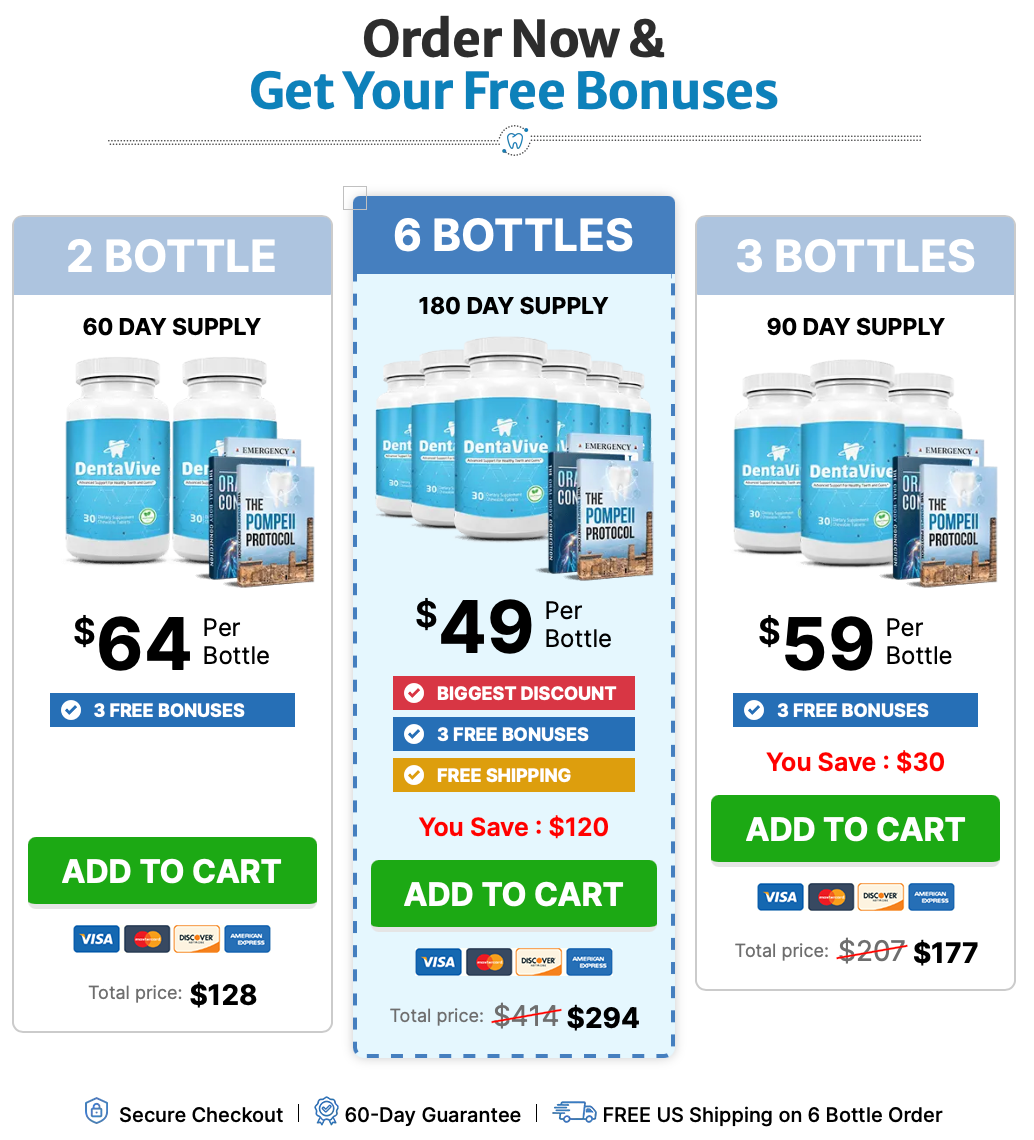
The approved DentaVive package artwork will appear here in the HTML version. Its price and guarantee statements are historical seller material until verified against the current checkout. View current offer.
Added ingredients need their own interpretation
Inulin is normally considered a prebiotic ingredient because it can be utilized by some microorganisms. Tricalcium phosphate is a mineral compound. Neither is interchangeable with live probiotic organisms, and their presence does not independently prove gum regeneration or reversal of dental decay. A product containing both probiotics and minerals needs evidence related to each claimed endpoint and the finished formulation.
When comparing multiple products, do not score a formula more highly merely because its list is longer. A short, transparent formula with strain-level research may offer clearer verification than a mixture whose constituent amounts are hidden. But that is a transparency judgment, not an efficacy ranking.
A practical six-step label comparison
First, record exact organism names. Second, identify strain codes. Third, note CFU per serving and its stated measurement time. Fourth, record storage and expiry. Fifth, check allergens, sugars, sweeteners, minerals and other ingredients. Sixth, compare the actual researched strain, exposure, population and endpoint. Missing information should remain visibly marked as missing.
Users comparing products for a particular oral goal should also review the MenPS gum-wellness guide and fresh-breath supplement guide. For a deeper scientific discussion, read MPS dental probiotic strains. The DentaVive product overview provides the approved commercial context.
Common ingredient questions
Can one species substitute for another? Not on the basis of its name alone; identify the studied strain and outcome.
Does more CFU mean better gum health? Not necessarily. The study-matched strain and dose are more useful than an unsupported ranking by total count.
Does inulin prove dental benefits? No. A plausible prebiotic role is not finished-product clinical evidence.
Has DentaVive's exact formula been clinically proven? That conclusion is not supported by the available uploaded evidence.
BUY PRODUCT — Ready to review the seller's options?
Choose on the basis of label transparency, personal fit and verified merchant conditions—not a promise of clinical results. The same approved product artwork will appear in the closing conversion module. Check the current DentaVive offer.
Editorial note: This is product-selection guidance based on desk research; the publisher has not personally tested DentaVive. No available source here demonstrates that the marketed finished product treats, cures or prevents a dental disease.
Selected sources and further reading
- Inchingolo F. et al. (2023). The Benefits of Probiotics on Oral Health: Systematic Review of the Literature. Pharmaceuticals 16, 1313. https://doi.org/10.3390/ph16091313
- International Scientific Association for Probiotics and Prebiotics (ISAPP). Decoding a Probiotic Product Label. https://isappscience.org/decoding-a-probiotic-product-label/
- American Dental Association. Home Oral Care. https://www.ada.org/resources/ada-library/oral-health-topics/home-oral-care/